
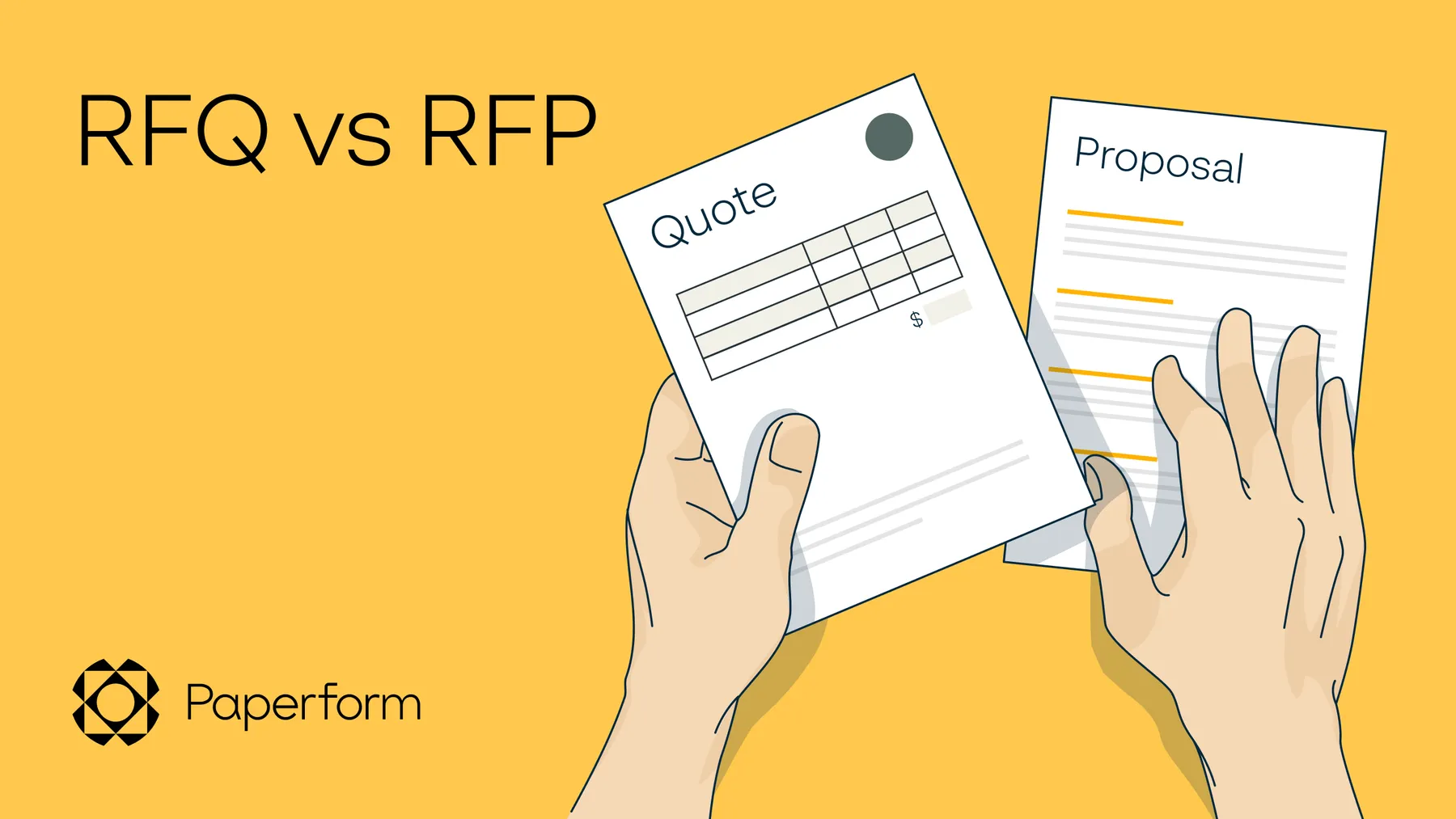
RFQ vs RFP: What's the Difference and When to Use Each?
An RFQ (Request for Quote) asks vendors to price something you've already defined down to the last detail. An RFP (Request for Proposal) asks vendors to propose how they'd solve a problem you're still scoping. Send out the wrong one and you'll waste weeks comparing apples to oranges, and once you've picked a winner, you still need a signed agreement, which is where Papersign, a free electronic signature app, takes over.
What is an RFQ?
RFQ stands for Request for Quote. It's the tool you reach for when you already know exactly what you need and just want to compare prices across suppliers.
Think of it as a detailed shopping list. You specify the exact products or services, the quantities, the specifications, and any delivery requirements. Vendors respond with a number: how much it'll cost them to fulfil your list.
RFQs work best for standardised, well-defined purchases where price is the deciding factor, not creativity or approach. Office supplies, raw materials, printing runs, and routine equipment orders are all classic RFQ territory.
What is an RFP?
RFP stands for Request for Proposal. You reach for this one when the project is complex enough that price alone won't tell you who's the right fit.
Instead of a shopping list, an RFP is closer to a brief. You describe the problem, the outcome you want, and any constraints (budget, timeline, compliance requirements), and you invite vendors to propose their own approach. Two vendors might solve the same problem in completely different ways, at different costs, with different trade-offs.
RFPs suit software implementations, marketing campaigns, construction projects, and any purchase where the "how" matters as much as the "how much."
RFQ vs RFP: the corrected comparison table
| Aspect | RFQ (Request for Quote) | RFP (Request for Proposal) |
|---|---|---|
| Purpose | Get a firm price on something you've already defined | Find the right vendor to solve a problem you're still scoping |
| Level of detail you provide | High: exact specs, quantities, and requirements | Moderate: you describe the problem and desired outcome, not a fixed spec |
| What vendors submit | A price quote against your fixed list | A full proposal covering approach, timeline, team, and cost |
| Deciding factor | Price, for a like-for-like comparison | Approach, capability, and value, not just cost |
| When you'd issue it | The project is fully defined and you're ready to buy | The project is still being shaped and needs vendor input |
What about RFIs?
A Request for Information (RFI) usually comes before either of the above. It's how you scope the market before you commit to a formal process.
An RFI asks potential vendors basic questions about their capabilities, experience, and interest, with no obligation on either side. It's less formal and less detailed than an RFQ or RFP, and its job is simple: help you build a shortlist. Once you know who's capable of doing the work, you follow up with an RFQ (if it's a defined purchase) or an RFP (if it's a complex project). Our dedicated RFI guide covers how to run one.
When to use an RFQ vs an RFP
Use an RFQ when:
- Pricing is the deciding factor and your requirements are already locked in
- You're purchasing standard, off-the-shelf products or services
- Speed matters more than exploring different approaches
- You need a straightforward, apples-to-apples price comparison
Use an RFP when:
- The project is complex or the scope isn't fully defined yet
- You want vendors to propose their own approach, not just a price
- Quality, capability, and compatibility matter as much as cost
- The engagement involves significant legal or contractual commitments
Once you've picked a vendor through either process, you'll usually need to formalise the relationship with a contract. If your team is fuzzy on the difference between terms like indemnity, force majeure, or an out clause, our contract terminology glossary breaks down the jargon in plain English before you sign anything.
FAQ
What is the difference between an RFQ and an RFP?
An RFQ asks vendors to quote a price on something you've already fully defined. An RFP asks vendors to propose how they'd approach a project you're still scoping, where cost is one factor among several.
When should a business use an RFQ instead of an RFP?
Use an RFQ when your requirements are locked in and price is the main decision point, like ordering standard supplies or equipment. Use an RFP when the project is complex, the scope is still open, and you need to compare different approaches, not just prices.
Is an RFI required before an RFP?
No, but it's common practice for complex or unfamiliar categories. An RFI helps you build a shortlist of capable vendors before you invest time drafting and evaluating a full RFP.
Can a single procurement process use an RFQ, RFI, and RFP together?
Yes. A typical sequence is RFI first to identify potential vendors, then either an RFQ (for a defined purchase) or an RFP (for a complex project) to get formal responses from that shortlist.
What happens after a vendor is selected through an RFP?
You move into contract negotiation. Once terms are agreed, both parties need to sign, and that's where an intake form paired with e-signature software saves the most time, since you can turn collected vendor details straight into a document ready for signature.
Once you've picked your vendor, get the contract signed fast. Try Papersign free and send it out for signature in minutes, not days.
Suggested reading
Papersign (“Papersign” or “we”) provides the information, data, links and other materials on this page (collectively, “Information”) for informational and educational purposes only. We do not warrant or represent the accuracy, completeness, currency, or suitability of any Information for any use or purpose. Papersign is not a licensed legal provider nor is it providing any legal advice; the Information should not be so construed or used. Nothing contained in the Information is intended to create an attorney-client relationship, to replace the services of a licensed, trained attorney or legal professional, or to be a substitute for the legal advice of an attorney or trained legal professional licensed in your state/jurisdiction. Before taking any action, including using our services to execute contracts or other documents, You should always first consult an attorney licensed in your state/jurisdiction, in each instance, regarding the issues address by the Information. Please never disregard professional legal advice or delay in seeking it because of something you have read in the information.